
The 2025 Guide to Padel Court Regulations and Dimensions (U.S. Edition)

Updated: Jan 27
If you’re planning to install a padel court in the United States - whether it’s for a private residence, club, school, or municipality - understanding the official dimensions and regulations is essential. Not only does this ensure player safety and gameplay quality, but it also helps avoid expensive compliance issues later. This 2025 U.S. guide explains:
Court size and structure
Glass, mesh, and flooring specs
Lighting, fencing, and safety zones
Regional codes (wind, snow, ADA)
U.S.-specific considerations
Official Padel Court Dimensions
The rules for padel court size are defined by the International Padel Federation (FIP) and recognized globally, including by the U.S. Padel Association.
Standard Padel Court Size
Length: 20 meters (65.62 ft)
Width: 10 meters (32.81 ft)
Total Area: 200 m² (~2,150 sq ft)

Court Surface
Recommended space around the court should be at least 1.5 meters (5 ft) clearance on all sides. This results in an ideal footprint including buffer of approximately 3,000 sq ft. Additionally, the court height clearance must be a minimum of 6 meters (19.7 ft), with 8+ meters preferred for indoor courts.
Structural and Wall Requirements
Glass Walls
The walls of the court play a crucial role in the game dynamics.
Material: Tempered safety glass (10mm thick)
Standards: Must comply with ANSI Z97.1 or ASTM C1048 standards in the U.S.
Features: Panels must be vibration-resistant and securely mounted to the steel frame.
Steel or Aluminum Frame
The frame is integral to the structure's durability.
Thickness: Minimum thickness of 3 mm steel tubing.
Compliance: Must meet local building codes for wind and seismic load.
Hurricane Zones: In areas like Florida, courts must be engineered for 140-160 mph wind resistance.
Mesh Fencing
The fencing forms a safety boundary while ensuring visibility.
Material: Galvanized or powder-coated steel mesh.
Grid Size: 5x5 cm or 5x4 cm.
Mounting: Must be mounted flush to prevent injury during wall play.

Playing Surface Requirements
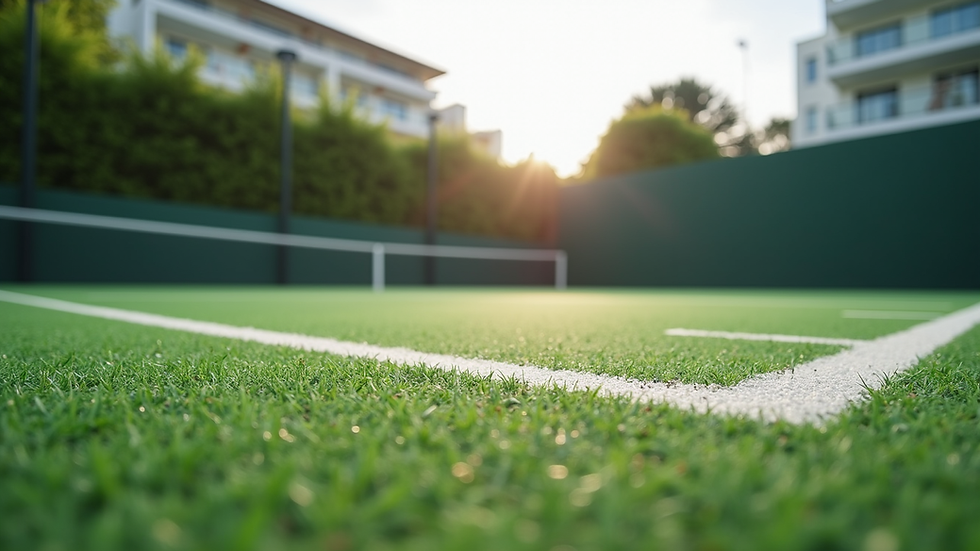
Turf Specs
The playing surface significantly impacts gameplay.
Type: Monofilament or fibrillated artificial turf.
Fill: Sand-filled (80%-90% infill).
Colors: Available in green, blue, red, or black (FIP-approved colors).
Specifications: UV-protected, non-slip, shock-absorbent.
Surface Performance
Meeting performance standards is critical.
Rebound: Ball rebound and player grip must meet FIP guidelines.
Drainage: A slight slope (max 1%) is allowed for drainage.
Lighting and Electrical Guidelines
Effective lighting is critical for player visibility and safety.
Pole Height: 6 meters (19.7 ft) or higher.
Fixture Type: LED, 200-400 watts per unit.
Light Count: 4-8 units per court.
Color Temperature: 5000K – 6000K (daylight).
Lux Level: Minimum 300 lux (recreational), 500+ lux (professional).
All Padel Craft courts include LED-compatible mounts. Full lighting systems are available as add-ons.

Covered Court Requirements (Optional)
For year-round play, many U.S. clients choose covered courts.
Canopy Specifications
The canopy protects against weather elements.
Type: Free-standing or attached steel/aluminum truss.
Height: Minimum height of 8 meters (26 ft) for bounce clearance.
Snow Load: Must meet ASCE 7-22 design standards.
Drainage: Integrated rainwater channels and slope.
Canopies help protect the court from UV, snow, and debris - extending turf life and boosting ROI.
Safety, Compliance & Accessibility
Americans with Disabilities Act (ADA)
Accessibility is essential for community courts.
Pathways: Courts should provide at least one accessible pathway.
Surface Transitions: Must be level.
Facilities: Clubhouses and restrooms should adhere to ADA guidance.
Wind and Seismic Loads
Padel Craft courts can be engineered for all U.S. regions, including:
Florida: Up to 160 mph wind resistance.
California: Seismic anchoring and flexible base plates.
Colorado & New York: Snow load and frost line adjustments.
Padel Craft provides state-specific engineering drawings sealed by licensed U.S. engineers upon request.
Common Mistakes to Avoid
Building a padel court can come with its pitfalls. Here are some common mistakes to avoid:
Using incorrect glass thickness.
No wind load or snow load engineering.
DIY installation or relying on cheap suppliers.
Insufficient buffer space for fencing or lights.
Non-compliant lighting.
U.S. Regional Considerations
Each U.S. region has key requirements based on climate and local codes:
Florida: Focus on wind resistance and corrosion protection.
California: Seismic anchoring and use of fire-safe materials.
Texas: High UV resistance and effective stormwater drainage.
New York: Snow load considerations and freeze-thaw foundation adjustments.
Arizona: Use sun-resistant turf and structural cooling features.
Padel Craft will tailor your court to meet local codes and climate conditions - eliminating guesswork.
Why Compliance Matters for Investors and Clubs
Building to regulation standards isn't just about safety - it's also about:
Warranty protection.
Insurance eligibility.
Increased resale value.
Approval for tournament hosting.
Long-term ROI.
Padel Craft USA builds every court to international and U.S. specifications, providing you with the confidence to launch your project successfully.
Why Choose Padel Craft USA?
Choosing the right provider can make a significant difference.
Compliance: We ensure full compliance with FIP, ITF, and U.S. building codes.
Installation Crews: Florida-based installation crews guarantee quality.
Warranty: A 10-year warranty on the metal structure offers peace of mind.
Experience: Trusted internationally since 2017, we supply padel courts nationwide, from California to New York.
Let’s ensure your court is built right, built safe, and built to win.
For more information, visit Padel Craft USA.


Comments